Tuesday, January 20, 2009

Homeschooling and Holiday Traditions

As I think about the 2008 holiday season, I realize that homeschoolling saved my holidays! I have to confess to being apathetic to the holiday season, appreciating the original intent of the holidays, but finding little meaning in the celebrations. Christmas, in particular, was very much an anti-climax. Then there was homeschooling!

Kids love holidays and are motivated to do all kinds of academic stuff disguised in holiday tradition. I needed to find some traditions! Last Christmas, I saw advent calendars and thought that would be a great addition to our holidays. I could create the activities that we would do every day. I also found out about Jessee Trees, a visual representation of Jesus' family tree, almost a biblical timeline of great moments leading up to Jesus' birth. Both these traditions involved several days of doing something leading up to Christmas, and I liked the idea of wallowing in the holiday, of milking it for all it really had. Great ideas, but by the time I got to implementation, Christmas was over!

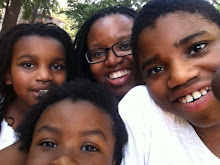
This year I was ready. We did a combination of advent activities, themed copywork, coloring pages and Jesse Tree craft and discussions for the entire month of December. The kids had a great time leading up to Christmas. I extrapolated meaning for myself from the discussions and activities and felt really good creating these experiences for the kids, and doing 'school' at the same time! So the picture above is of our Jesse tree, symbols drawn and colored by all of us (ignore the date on the camera, please!)

Here are some other things we did:

  • We had an actual Christmas tree with lights! And we put gifts under it. Next year it may get some tinsel.

  • We put lights on our window and our fence.

  • We made Christmas themed soaps for our friends and family as holiday gifts.

So we had a great time creating meaning for ourselves. The kids enjoyed the activities and I have a new set to add, to enrich my traditions in 2009. Like having a Boxing Day box, to collect gifts for the community.....


Thursday, January 8, 2009

Play with Math using Rods and Gattegno!!!

Just a quick note about the wonderful method of exploring and internalising Mathematics that we recently found. I encourage you to investigate it for yourself. It was pioneered by Caleb Gattegno and uses Cuisenaire rods. I can't describe the experience, but I have done mathematics to the graduate level and taught it to the college level, and trust me, there is a lot that I do not understand. So much of mathematics seems to be the following of rules that you just don't 'get'. At my ripe old age, I'm just understanding what they meant when i was 'carrying the 1' in subtraction! So, as a homeschooler, I really want my kids to 'get'.

Gattegno's method helps the children to become familiar with mathematics in a very intuitive and visual way. More details on his methods later, maybe, but take a look at Simonne and Zachary exploring concepts that are become second nature (instead of rote learning math facts). So here is Simonne looking at all the ways to make rods of length 11 units. I think she was more excited about building the wall! She then wrote out that O+W = Bl + R and so on, also becoming familiar with algebraic notation.


Here is Zach building a ladder, which is just him becoming familiar with the order of the rods when there is only a difference of one unit. The visual piece is so important and leads to such wonderful realizations later on. They start to 'see' the mathematics.

Of course, we don't only have to build walls and ladders!!!


I'm excited about this because I've found the method to teach Jaedon math, when he is ready for it. I have heard that this works so well with special needs kids, who may not get the 'rules' of mathematics, but just start to 'see it'. Whatever you do, keep looking for methods and approaches that are right for your kids. If they aren't out there, you can create one!


Monday, October 13, 2008

I LOVE markable maps!!!

This picture shows why I love markable maps. Well, first, let me give some background. I hated geography. I just didn't relate. Drawing the shapes of countries and rivers and hearing about their weather and vegetation did not interest me.

This year, I've decided to more fully use the Sonlight curriculum that I have had for some time. I started one of the grade 2 readers with Simonne, Clara and the Bookwagon. The setting is Maryland in the early 1900's. We talk about setting, then follow Sonlight's encouragement to find Maryland on the map. Well, I didn't know, so we found out together. My goodness! A whole new world was opened up. We continued by finding all the states we could recognise, then Simonne found a puzzle of the U.S. that was labeled and she spend a long time using it to identify states on our markable map.
THEN, I decided to continue on this vein, and introduce continents and oceans. Can I tell you that I had no previous idea about any of the oceans before this? Honestly, I remembered the location of the Caribbean Sea and the Mediterranean Sea. It was really exciting for me to find out where these were and have Simonne eagerly labeling the places. I even offered to write the labels for her and she just point them out, but she wanted to write herself (this is the former reluctant writer!) We have a cute little song about the continents and oceans singing and Zachary is singing along. I love homeschooling!!!
Every day since, in every book we read, we note the places mentioned, and look for them on the map sometime shortly after. What a life!

Thursday, October 2, 2008

What happens to seeds when we plant them?


There has been a sudden interest in seeds and plants recently. I think it started with a visit to our friend Carmen's home and her guided exploration of the garden and all that plants need. A few weeks later, we planted our first set of seeds: beans, tomato and green peppers. It may be a little late in the year for peppers and tomatoes, since they aren't thriving like the beans.

I love projects like these that can be used to explore so many things. Take a look at our germination bags (talked about condensation) and out Popsicle sticks for labeling (handwriting), our very well sprouted beans, and less mature mung beans which were added a few weeks later and our window planter that had our transplanted plants (plant care, how delicate young plants are .... since a few of our beans died with the handling). We worked on some sensory issues (chiefly mine) since we had to handle the dirt to transfer the plants to the planter. We also discovered that young plants that have been bent, not broken, can reinforce the bent area and straighten itself.. and that Jaedon
loves to poke dirt and dig out small plants. we just have to help him to
identify which plants are weeds and which plants stay in the dirt!

Homeschooling allows me to learn alongside my children. I realised that children are like plants. They grow in the right environment, they are resilient and can recover from some mishandling (whew!), they grow towards the sunlight (praise and everything positive) and that so much is happening for them, even when I don't see it. I realise that learning is like breathing, it's happening all the time while they are alive.


Monday, September 1, 2008

Soap and Math

I really enjoy the times when learning happens and comes from a genuine desire from the child to really 'get' something. I really think all learning should be that way. Think about it. How many things did you learn because you 'should' and you just forgot afterwards? Even rudimentary things like ABC's and counting were done to music and using stuff we were interested in ("Johnny, do you want one cookie, or 2?")


I encouraged Simonne to start making soap for 2 reasons: so she could make some money to start attacking the list of toys she wants, and to help her make math practical. So here's a pic of the soaps. They are 50 cents each, so people often pay her in quarters. I asked her one night, what's 25 and 25? I was sure she knew, the amount of times we had done this. she said "About...45 cents?" and I figured she had no idea. A little testily, I explained in about 3 different ways, how to add 25 and 25. We used regular sum notation, base 10 blocks and counting by 5's on fingers. I wrote it up on the blackboard side of the easel. Some time later, I saw this on the white board side! She wrote out what I had on the board, expanded on it and added some annotations of her own! She said "Look Mommy, is this math?" I had an enthusiastic affirmative. Of course, I was suspicious. Did she really get it? Was she just copying what I did on the board? A few days later, I found out. We emptied the piggy bank, and started counting the money. She counted 2 quarters with no problem, then we moved on to the problem of 50 cents plus 50 cents. She got it!


Tuesday, August 12, 2008

Table Work!!!

I cannot describe to you the struggle this has been for me. Simonne isn't a fan of writing so anything that is done sitting at a table (maybe except painting) is seen as a chore. She has a phonics workbook that has been like torture, and a math workbook that I am on the verge of throwing out (except maybe Zachary might...). Do I force the issue to teach discipline and increase the torture? Do I bribe them with computer time to get writing done? Do I hope to access their motivations and tie them into writing? On good days, I'm calm, no need to force the issue, I say. Don't we create motivating games in Jaedon's program that tie in his educational goals? "I can do that for the typical children!", I say, to encourage myself, then promptly sit and do nothing but worry.

Well, I have no idea what happened today! No, that's not true, I was just surprised at what happened. Zachary has a coloring fetish and will do anything in a workbook. His fine motor is exceptional for his age and writing is fun for him. He's just not required to do 'table work', he's 4! Anyway, he got a new book with some activities for drawing, pictures to look at and discuss with someone. When I sat with him to talk about his book, Simonne announced she wanted to do a workbook! I hurried to get her one, and she worked easily through 3 pages, the entire section on l-blends! (on the inside, my jaw is dropped). Zach moves on, she loses motivation, we argue about finishing what we start, I threaten, etc. Later that evening, Zach picks up his book again, she also picks up hers. She does 2 more pages - starting r-blends! A month's worth of workbook pages in a day!

There's Simonne in the picture proudly displaying the sentence she made up with l-blend words.


So now I just have to keep Zach motivated.... there I go again? Why do I feel it is my job to motivate?

Saturday, August 2, 2008

Turtles Teach Condensation!


We've been pet-sitting 2 Red-Eared Sliders (Tumble and Mumble) for the past 2 weeks. Watching them has taught us many things, including this concept - I hate changing the water! I think we will either get a tank with all the filters so that the water stays clean all the time, or else no aquatic animals until the children can do EVERYTHING themselves.
Anyway, the question was asked today, "How come the water in the tank looks less than it did a few days ago? Are the turtles getting bigger?" "That's because of evaporation", I said. "What's evaporation?" I was busy with the computer, so it took me a few minutes to hear the lesson in the making. Given my constant cry that we don't do exciting stuff in our homeschool, I tore myself away and hurriedly set up....A SCIENCE EXPERIMENT! You can tell I'm excited. Preparation isn't one of my strong points. Any setup that requires more than a minute doesn't get done. I ran to the stove, put a pot of water on to boil, and started to talk about evaporation. As we watched the water disappear from the pot, I put ice in a cup and talked about condensation. Put the cup of ice over the pot on the stove and showed condensation almost immediately (I know, I am a genius). It was exciting to hear Simonne speculate that the water in turtle tank was evaporating slowly because the air isn't as hot as the stove. 15 minutes of science, I love it!
By the way, watching the turtles taught us many things:
  • The bottom of the turtle shell is black and yellow.
  • They wipe their faces and each others faces
  • They sleep with their legs both in and out of their shells
  • They love to climb onto each other and will stay like that for hours!
  • They have no teeth
  • We wash our hands after handling them
  • They close their eyes by bringing the bottom lids up
  • They stretch their necks and legs
  • If the turtle falls and lands on it's back (as they have done many times), it can flip itself back over with ease.
  • They make a sound like air escaping when they are not happy
  • They have claws
  • They look like they yawn

just to name a few.

Step Up and Make a Difference!!!

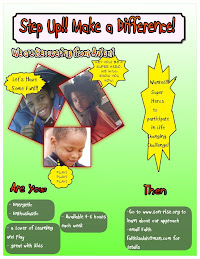
You’re invited to join us and be part of this move to change the autism world for the better. You will make a difference in our children’s lives and recharge your own sense of life and well-being. We are now interviewing people with a variety of skills and interests, who want to participate with us and learn the Son-Rise program (www.son-rise.org) in depth. No previous experience is required, as all training will be provided. Days and times are flexible, but commitment is required.

You can work in any combination of the following three areas, as your time and interests allow:
· Work with a child on a one-to-one basis. You will work as a part of the child’s team, receiving regular training and feedback about how to build an effective and meaningful relationship with the child and how to tap into his core motivations and use those to help him accomplish important goals. You will attend regular goal setting and brainstorming meetings with the team and his parent.
· Work with development on fundraising projects. You will help to fundraise for additional training for interns and families running Son-rise programs.
· Helping spread the word through the media. You will help to contact appropriate media sources, write articles and letters to spread the word about our work and to attract other interns and families to our program.

If you are interested, contact Faith Clarke at faithisaiah@msn.com to receive an info packet and to find out when the next informational session will be held.